
Why Falling Mining Difficulty Sounds Exciting, but Still Does Not Turn a Small Miner Into a Reliable Source of Income
In Bitcoin mining, there are a few numbers that can quickly sound impressive: hashrate, difficulty, block time, network hashrate, power consumption. Mining difficulty in particular comes up again and again when people talk about whether mining is currently becoming easier or harder.
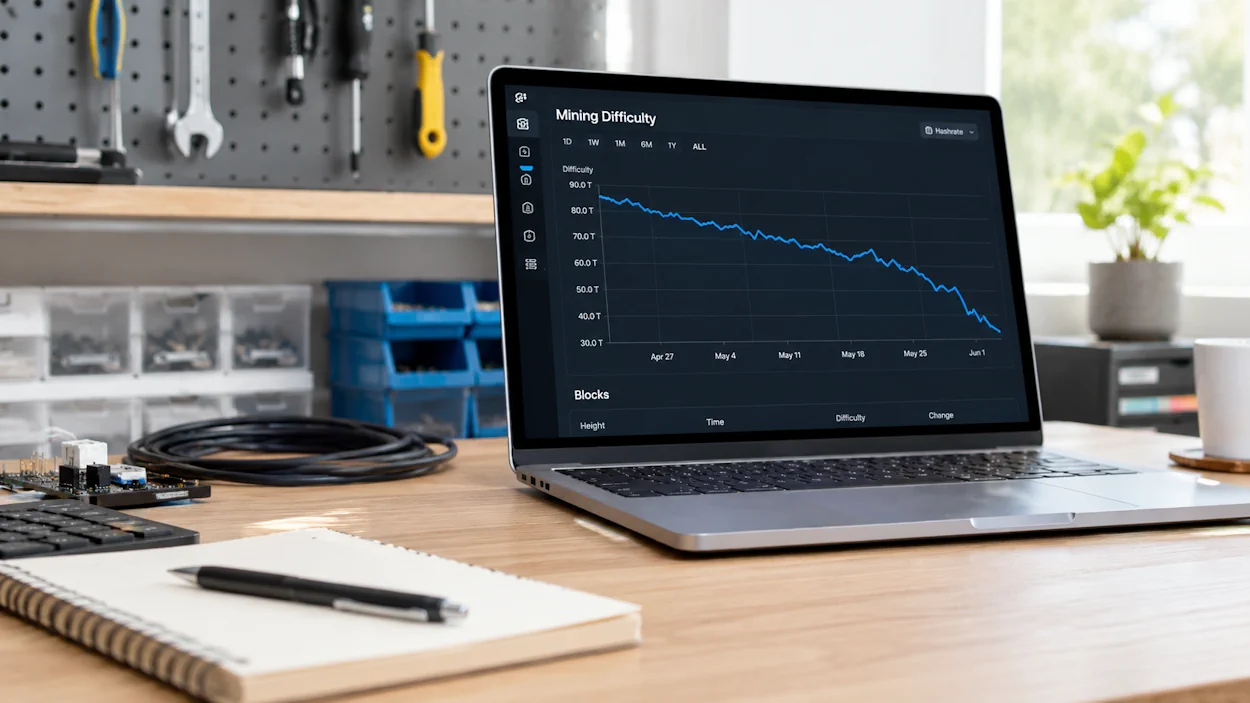
Right now, this is once again an interesting topic. Bitcoin mining difficulty has recently dropped significantly. At the same time, current network data already points to a possible increase at the next adjustment. For large miners, this is an important economic factor. For small miners like the Bitaxe Gamma 601, it is mainly a good reason to take a closer look at the technology behind it.
Because yes: a lower difficulty means that mining becomes slightly easier from a purely mathematical point of view. But no: it does not turn a small miner with around 1 TH/s into a predictable source of income.
What Does Bitcoin Difficulty Actually Mean?
Bitcoin difficulty determines how hard it is to find a valid block. It helps ensure that, on average, a new Bitcoin block is found about every ten minutes.
When a lot of mining power is active worldwide, blocks tend to be found faster. In that case, the difficulty increases at the next adjustment. When mining power leaves the network, blocks tend to be found more slowly. Then the difficulty can decrease.
This adjustment happens roughly every 2,016 blocks. That is about two weeks if the average block time is close to ten minutes.
Difficulty is therefore a kind of automatic regulator in the Bitcoin network. It adjusts the level of difficulty to the available computing power.
Why Has Difficulty Fallen Recently?
When difficulty drops significantly, it usually indicates that less hashrate was active in the network. There can be several reasons for this.
Some miners shut down when operation is no longer profitable. Others move locations, maintain equipment, or react to electricity prices. Seasonal effects related to energy supply and cooling can also play a role.
For large mining operations, this matters a lot. A difference of only a few percent in difficulty, electricity cost, and Bitcoin price can decide whether mining is still profitable.
For small hobby miners, the situation is different. A Bitaxe Gamma 601 is usually operated with a completely different goal. This is usually not about industrial profitability, but about technology, learning, solo mining, and personal projects.
What Does Lower Difficulty Bring to a Small Miner?
Technically, a lower difficulty improves the chance of every individual miner finding a valid block. This also applies to small miners.
But the key point is the ratio.
A Bitaxe Gamma 601 is typically somewhere around 1.0 to 1.3 TH/s. For a small device, that is respectable. Compared to the total Bitcoin network, however, it is extremely small.
So if difficulty drops by a few percent, the theoretical chance of a small miner also improves by only a few percent. But when the starting probability is already tiny, the result is still tiny.
A simple way to put it:
If the chance is extremely small and it improves by a few percent, it remains extremely small.
That is exactly why falling difficulty should not be confused with “now solo mining is profitable.”
Solo Mining Remains a Lottery
With solo mining, the miner works toward finding its own block. If it actually finds a valid block, that would be an extraordinary hit. That is exactly what makes solo mining exciting.
But it remains a lottery.
A small miner like the Bitaxe Gamma 601 technically participates in mining. It calculates hashes, connects to a solo pool, and does its work. But the chance of finding a block is so low that the device should not be considered a source of income.
Falling difficulty does not fundamentally change that. It can improve the theoretical chance, but it does not move it into a range that can be planned around.
This matters because otherwise it is easy to develop false expectations. The Bitaxe Gamma 601 is exciting because it makes mining understandable. Not because it reliably earns Bitcoin.
Difficulty, Hashrate, and Power Consumption Belong Together
In mining, it is not enough to only look at hashrate.
A miner has to provide computing power. For that, it needs electricity. The higher the difficulty, the more competition there is for the next block. Large miners therefore have to pay very close attention to efficiency.
With a small miner like the Bitaxe Gamma 601, the situation is different. The power consumption is typically only in the range of a few watts to a few dozen watts. That keeps the operating costs manageable. But the hashrate is also correspondingly small.
That is what makes the Bitaxe interesting as a learning and hobby device. You can run it continuously, observe measurements, and gain practical experience without operating a large mining setup.
For real profitability, however, that is not enough. The low power consumption is nice, but it does not solve the basic problem of the extremely low probability of finding a block in solo mining.
What I Take Away From the Current Difficulty Movement
For me, the current development mainly shows one thing: Bitcoin mining remains dynamic.
There is no fixed situation that stays the same forever. Difficulty, hashrate, electricity costs, miner efficiency, and the Bitcoin price are constantly moving. Large miners have to react to this economically. Small miners can observe the whole thing from a technical point of view.
That is exactly what makes the Bitaxe Gamma 601 interesting. It is not a device I run because of expected profits. It is a device that helps me understand mining in practice.
So when difficulty falls, it is not an invitation to unrealistic expectations. It is more of a good moment to look at how Bitcoin keeps block time stable and why mining at network scale works very differently from mining on your own desk.
What Does This Mean Specifically for the Bitaxe Gamma 601?
For the Bitaxe Gamma 601, falling difficulty means:
- The theoretical chance of finding a block improves slightly.
- The practical expectation remains extremely low.
- Solo mining remains a technical lottery.
- The learning value remains high.
Difficulty should be seen as an interesting network parameter, not as a profit signal.
That is the cleanest way for me to look at it. Anyone running a Bitaxe Gamma 601 should not turn every difficulty drop into a huge opportunity. It is better to watch the development and learn from it.
My View on It
I find this exact combination interesting. On one side, there is a small device with around 1 TH/s sitting on the desk. On the other side, there is the global Bitcoin network with enormous computing power.
Difficulty sits in between. It connects the small miner to the large network.
The Bitaxe Gamma 601 shows me my tiny share of this system. Not exaggerated, not romanticized, but quite directly. Hashrate, temperature, pool status, uptime. Alongside that, the network data from Bitcoin. That is already enough to understand mining better.
Anyone looking for reliable income is in the wrong place here. Anyone who wants to understand the technology is exactly right.