Yes, it can.
But that sentence needs some context. Possible does not mean likely. And possible also does not mean that you can calculate a reliable income from it.
Solo mining is basically about hashrate, mining difficulty and luck. Every miner is looking for a valid block. Large mining farms simply have millions or billions more attempts than a small device on a desk at home. A small miner has only a tiny chance. But that chance is not zero.
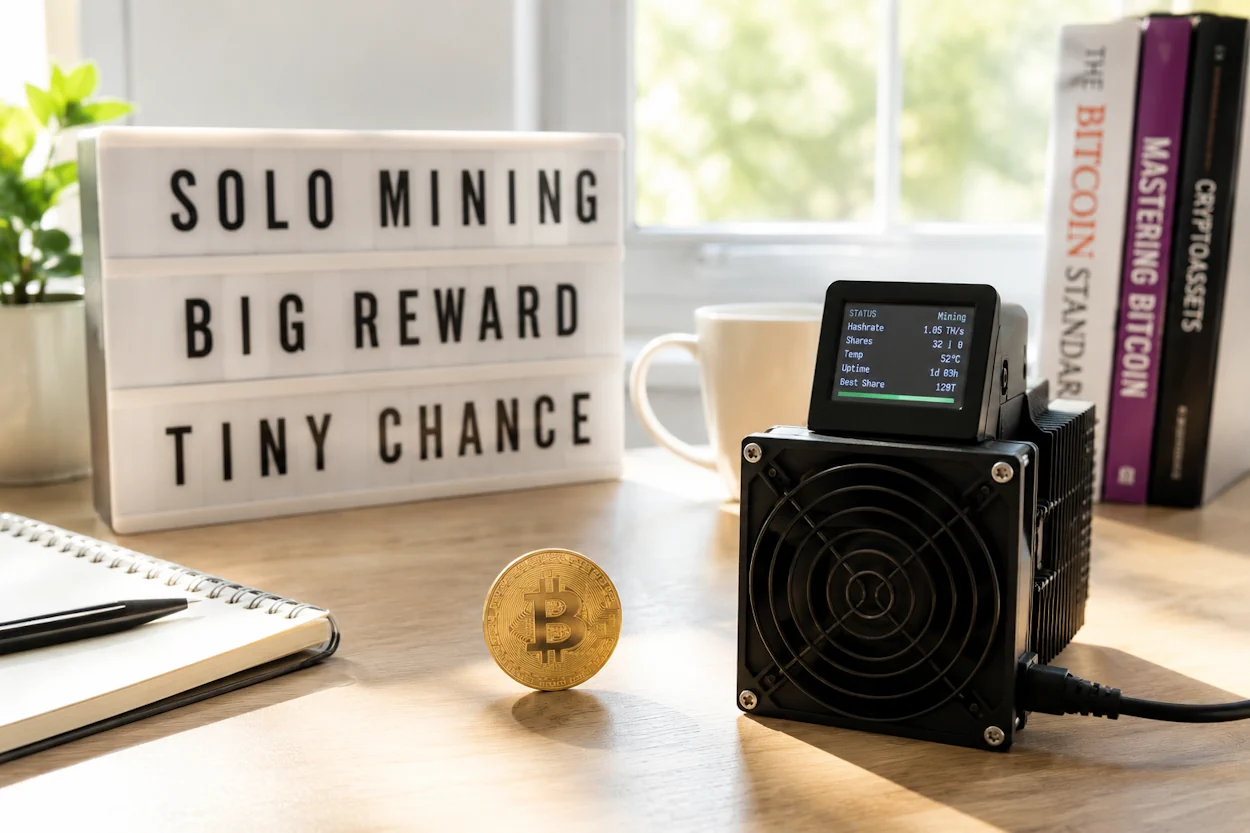
That is exactly what makes solo mining so interesting. Small devices like a Bitaxe or other compact ASIC miners are not money printers. They are more like a technical Bitcoin lottery ticket. They use electricity, produce heat and show you quite clearly how Bitcoin mining actually works.
The known case: around 6 TH/s and still a block
In November 2025, a particularly interesting case was reported. A solo miner with only around 6 TH/s apparently found Bitcoin block 924,569 via Solo CKpool. The reported reward was around 3.146 BTC, consisting of the fixed block subsidy plus the transaction fees included in that block. ForkLog reported the same block number, the 6 TH/s hashrate and the 3.146 BTC reward. Tom’s Hardware also covered the case and referred to CKpool creator Con Kolivas as confirmation for the unusually low hashrate.
One important detail: the Bitcoin blockchain shows the block and the payout. It does not show the exact hashrate of the miner who found it. That information comes from the pool operator side and from reports based on that information.
Still, the case is plausible and technically understandable. CKpool is built exactly for this kind of setup. According to the official CKpool website, it is not a normal pooled payout system. It is a service that allows miners to mine solo blocks without running the full solo mining infrastructure themselves.
What does that mean for small miners like Bitaxe?
A small miner is not doing “fake” mining. If it is set up correctly, it performs real SHA-256 work and takes part in Bitcoin mining.
The difference is not whether the mining is real. The difference is scale.
A Bitaxe with a few hundred GH/s or a little over 1 TH/s is competing against a network that operates at a completely different level. Compared with the total Bitcoin network, a single small miner is almost invisible.
But invisible does not mean excluded. It only means that the probability is extremely low.
Think of it like a lottery. One ticket can win. Someone with millions of tickets has a much better statistical chance. But the single ticket is still a real ticket.
In solo mining, your hashrate is that ticket.
Why the odds are so low
Bitcoin is designed so that, on average, a new block is found roughly every ten minutes. To keep that timing stable, the mining difficulty adjusts regularly. When more global hashrate enters the network, finding a valid block becomes harder. When hashrate leaves, the difficulty adjusts down.
For small miners, this means one thing: they are not competing against a few hobby miners. They are competing against the entire Bitcoin network.
That is why a small miner can theoretically find a block. In practice, however, it may run for years without ever finding one.
This is the part that needs to be separated clearly:
Possible: yes.
Predictable: no.
Reliable income source: no.
What CKpool does
Many small solo miners use Solo CKpool. The service does not remove the risk. It only makes solo mining easier.
According to the official CKpool website, miners can connect directly to the CKpool server and use their own Bitcoin address as the username. CKpool also states that no registration is required, there are no payment schemes and no pool operator wallet sits in between.
That is the key difference compared with regular pool mining.
With regular pool mining, many miners combine their hashrate and receive smaller, more regular payouts. With solo mining via CKpool, there are no small ongoing rewards. If you do not find a block, you get nothing. If you do find a block, the reward goes to your submitted Bitcoin address, minus the CKpool fee. CKpool states a 2 percent fee on its official website.
That is harsh, but clear.
How big would the reward be?
Since the Bitcoin halving in April 2024, the fixed block subsidy has been 3.125 BTC per block. On top of that, the miner receives the transaction fees included in the block. Investopedia also describes the April 2024 halving as the event that reduced the block reward to 3.125 BTC.
That is why reported block rewards are often slightly above 3.125 BTC. You may see numbers like 3.13 BTC, 3.14 BTC or 3.15 BTC. That is the fixed subsidy plus the transaction fees from that specific block.
In the reported 6 TH/s case, the total reward was around 3.146 BTC.
Why do people do this at all?
Not because they expect safe monthly Bitcoin income.
Most people do it for different reasons.
- They want to see hashrate, temperature, voltage, shares and efficiency live.
- They want to experiment with hardware, cooling, power supplies and settings.
- They want a small piece of Bitcoin infrastructure running at home.
- And yes, they also have a tiny ticket in the Bitcoin mining lottery.
That is where devices like Bitaxe become interesting. They are compact, relatively efficient and much easier to understand than a large industrial miner. You can actually see what is happening instead of only looking at a number in an app.
What to take from this
A small solo miner can really find a Bitcoin block. The reported 6 TH/s case shows that this is not just theory.
But it should not create the wrong expectation.
A Bitaxe or another small ASIC miner is not a reliable income machine. It is a hobby device, a learning project and, on the side, a very small Bitcoin lottery ticket. That is the right way to look at it.
Anyone expecting regular income from small-scale solo mining will most likely be disappointed. But anyone who wants to understand Bitcoin mining, enjoys the hardware side and accepts that the odds are tiny may still find it very interesting.
Because in the end, this is not a toy. It is real Bitcoin mining technology. Just very small.