
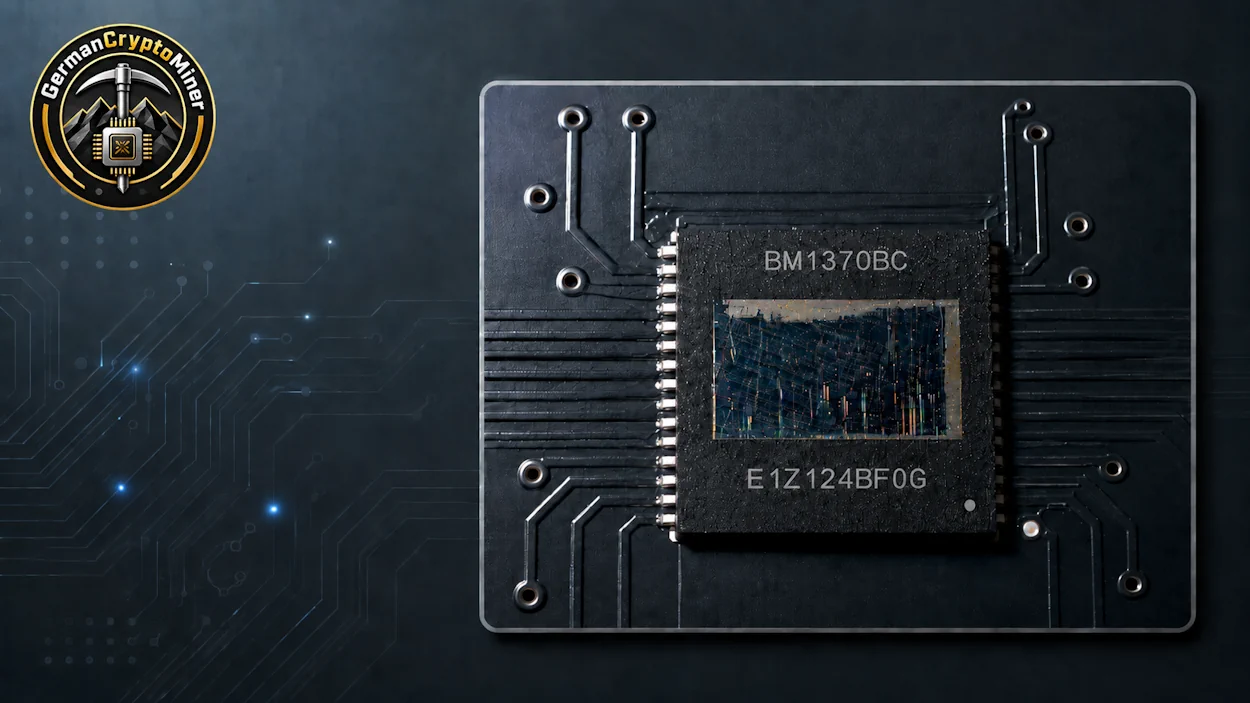
Why This Small Chip on the Board Explains More About Bitcoin Mining Than Many Theoretical Texts
At first glance, the BM1370 in the Bitaxe Gamma 601 looks rather ordinary. A small black chip on a circuit board, a heatsink on top, a fan above it, done. Technically, however, this chip is the actual core of the miner.
The Bitaxe Gamma 601 does not live from its display, Wi-Fi, or web interface. Those parts make the miner usable and visible. The actual mining work happens inside the ASIC chip. In the Gamma 601, that chip is the BM1370 from Bitmain.
On my chip, the marking BM1370BC is visible. These additional letters are interesting, but they are not publicly explained in a clean and reliable way. That is exactly why it is worth taking a closer look: What can really be said about the BM1370? What is documented? And what should not be claimed without a solid source?
What Is the BM1370?
The BM1370 is a Bitcoin mining ASIC from Bitmain. ASIC stands for “Application Specific Integrated Circuit.” It means a chip that was developed for one specific task. In the case of the BM1370, that task is Bitcoin mining using the SHA-256 algorithm.
A normal processor can calculate many different things. An ASIC, on the other hand, is specialized. It is not designed to run an operating system, edit images, or start general-purpose programs. It is designed to perform one specific computing task as efficiently as possible.
In Bitcoin mining, that means:
Calculating SHA-256 hashes.
This specialization is exactly what makes ASIC miners so powerful. Within their narrow field of use, they can work much more efficiently than normal computer hardware.
BM1370 and Bitaxe Gamma 601
The BM1370 is the ASIC chip used in the Bitaxe Gamma and Bitaxe Gamma 601. The Bitaxe Gamma project describes the miner as a Bitaxe variant based on the BM1370 from the Antminer S21 Pro.
That is an important point. The Bitaxe Gamma 601 does not use just any simple hobby chip. It uses a modern mining ASIC from the environment of industrial Bitcoin miners.
In the Antminer S21 Pro, many of these chips work together. In the Bitaxe Gamma 601, only one BM1370 is used. This makes it very clear what a single modern mining ASIC can do.
That is exactly what makes the Bitaxe Gamma 601 technically interesting. You are not only looking at a finished large miner, but can observe a single ASIC on a small scale.
The Connection to the Antminer S21 Pro
The Antminer S21 Pro is an industrial Bitcoin miner from Bitmain. It is specified with a hashrate of 234 TH/s, a power consumption of 3510 W, and an efficiency of 15 J/TH.
The Bitaxe Gamma project points out that the BM1370 comes from the Antminer S21 Pro. It also gives a derivation based on the number of chips: three hashboards with 65 chips each, so 195 chips in total.
That results in a simple calculation:
234 TH/s divided by 195 chips equals roughly 1.2 TH/s per chip.
This fits well with the typical values for the Bitaxe Gamma 601. Depending on settings, cooling, firmware, and chip variation, a single BM1370 in the Bitaxe environment is usually somewhere around 1.0 to 1.3 TH/s.
However, this is important:
This is a practical order of magnitude, not a guarantee for every individual device.
The Most Important Technical Data
| Specification | Classification |
|---|---|
| Chip series | BM1370 |
| Visible marking | BM1370BC |
| Manufacturer | Bitmain |
| Chip type | Bitcoin mining ASIC |
| Algorithm | SHA-256 |
| Known use | Antminer S21 Pro, Bitaxe Gamma / Gamma 601 |
| Typical single-chip hashrate in the Bitaxe environment | approx. 1.0 to 1.3 TH/s |
| Derived nominal performance per chip | approx. 1.2 TH/s |
| Efficiency class | approx. 15 J/TH |
| Documentation status | no complete public Bitmain datasheet found |
| Open source? | Bitaxe hardware/firmware yes, BM1370 chip itself no |
This table also shows the limits of publicly available information. Quite a lot can be said about the BM1370 with reasonable confidence. But not everything that would be technically interesting is publicly documented.
What Does 15 J/TH Mean?
The value J/TH means joules per terahash. It is an important efficiency metric in Bitcoin mining.
Put simply:
The lower the J/TH value, the more efficiently a miner works.
If a chip reaches around 1.2 TH/s and the efficiency class is around 15 J/TH, the calculation is:
15 J/TH × 1.2 TH/s = roughly 18 W.
This fits the typical order of magnitude in which the Bitaxe Gamma 601 operates. In practice, however, real power consumption does not depend only on the ASIC.
Other parts also contribute:
- Voltage converters
- ESP32 or controller
- Fan
- Display, if installed
- Power supply losses
- Firmware settings
- Voltage and frequency
- Cooling
That is why it would be wrong to say: “The BM1370 always consumes exactly 18 W.” A cleaner statement is: In the Bitaxe Gamma environment, the order of magnitude is typically in this range, depending on settings and hardware setup. On my Bitaxe Gamma 601, it is currently usually around 20 W.
Why a Single Chip Can Reach More Than 1 TH/s
For someone who has not followed Bitcoin mining for long, 1 TH/s from a small chip sounds impressive. And it is. The reason is the extreme specialization.
The BM1370 does not have to perform general computing tasks. It is optimized for SHA-256 mining. This allows a single chip to reach a level of computing performance that cannot really be compared to normal computer hardware in a meaningful way.
But that does not mean that a single chip is large in terms of the Bitcoin network. From the perspective of a small device, 1 TH/s is a lot. From the perspective of the global Bitcoin network, it is extremely little.
This double perspective is important:
- On the desk, a BM1370 is impressive.
- In the global Bitcoin network, it is tiny.
What Does BM1370BC Mean?
My chip is marked BM1370BC. The first part is clear: BM1370 refers to the chip series. The additional letters BC, however, are not publicly explained in a reliable way.
It is reasonable to assume that such letters may refer to variants, revisions, production markings, or binning classes. Spare-parts suppliers list different BM1370 markings. This shows that several markings exist.
However, you should not derive too much from this without evidence:
- BC is not automatically “better.”
- BC is not automatically a guaranteed performance level.
- BC should not be described as a fixed quality class without a source.
A more careful wording is better:
The visible marking on the chip is BM1370BC. The additional marking BC apparently indicates a variant within the BM1370 series. I could not find a publicly reliable explanation from Bitmain for the exact meaning of these letters.
That is more honest than making a statement that sounds precise but cannot be verified.
Open Source in the Bitaxe – but Not in the Chip
One important point is easy to misunderstand: The Bitaxe is an open-source project. The BM1370 itself is not an open-source chip.
The Bitaxe project makes hardware design, firmware, and documentation openly available. You can study the board, the design, the software, and the configuration. That is exactly what makes Bitaxe interesting.
The ASIC chip itself, however, comes from Bitmain. It is proprietary and not fully publicly documented.
That is not a contradiction. It is more or less typical for this kind of project. The community builds open miners around available industrial ASIC chips. The open part is the miner design, the firmware, and the documentation. The actual ASIC remains a specialized component from the manufacturer.
Why Cooling Is Important for the BM1370
The BM1370 is small, but powerful. That creates heat, and the heat has to be removed properly.
In the Bitaxe Gamma 601, the heatsink sits directly on the chip. Between the chip and the heatsink, there is thermal paste or a comparable thermal interface material. The fan then helps transfer heat from the heatsink to the surrounding air.
If this thermal transfer is poor, the temperature rises. This can be caused by:
- Too much thermal paste
- Too little thermal paste
- Old or dried-out thermal paste
- Poorly seated heatsink
- Blocked airflow
- Weak fan
- Dust
- Voltage or frequency set too high
With the BM1370, you should therefore not only look at hashrate. Stable temperature is at least just as important.
A miner that runs at a slightly lower clock but stays stable and cool is often more useful in everyday operation than a miner that briefly reaches high values and then runs into thermal limits.
Voltage, Frequency, and Hashrate
In the Bitaxe environment, hashrate and ASIC behavior can be influenced by voltage and frequency. A higher frequency can bring more hashrate. A higher voltage can support stability at higher clock speeds. Both, however, also increase power loss and heat.
That is the classic technical trade-off:
- More clock speed
- More performance
- More heat
- More cooling demand
- Possibly lower efficiency
For the BM1370 in the Bitaxe Gamma 601, this means: the goal should not be to blindly set the highest possible values. A stable setup with good temperature, clean power supply, and reliable pool status is more useful.
Of course, there is also a certain appeal in pushing the miner toward its limits. This can be done with better cooling and targeted settings.
BM1370 Compared to Older Bitaxe Chips
The different Bitaxe generations use different ASIC chips from different Antminer generations. Older Bitaxe variants use older Bitmain ASICs. The Gamma uses the BM1370 from the S21 Pro environment.
This increases the possible hashrate significantly compared to older single-chip mining devices. At the same time, power supply and cooling become more demanding.
This is a typical development step in ASIC miners:
- Newer chips become more efficient.
- Hashrate increases.
- Thermal design remains important.
- Requirements for the board, power supply, and cooling increase.
The BM1370 shows this development very clearly on a small scale. It brings modern ASIC performance onto a single small board.
What Can Be Said About the BM1370 With Reasonable Confidence
Several points can be said about the BM1370 with good confidence:
- It is a Bitcoin mining ASIC from Bitmain.
- It works for SHA-256 mining.
- It comes from the environment of the Antminer S21 Pro.
- It is used in the Bitaxe Gamma / Gamma 601.
- A single chip in the Bitaxe environment typically runs at around 1 TH/s or slightly above.
- Its efficiency class is around 15 J/TH.
- The chip itself is not open source.
- Public documentation is limited.
- Cooling, voltage, and frequency have a major influence on operation.
These points are already enough to classify the chip technically in a meaningful way.
What I Would Not Claim
It is just as important to say what should not be claimed.
Without a reliable source, I would not claim:
- Which exact manufacturing process the BM1370 uses
- How many transistors it has
- Which exact internal architecture is used
- What the additional BC marking exactly means
- What the absolute maximum temperature for the bare chip is
- That every BM1370 is guaranteed to reach 1.3 TH/s
- That one specific marking variant is better than another
- That the chip itself is open source
Especially with specialized chips like this, caution is better than fake precision. Many figures on the internet are copied from one place to another without it being clear where they originally came from.
My View
The BM1370 is the point where the Bitaxe Gamma 601 becomes technically interesting. It is not a toy chip, but a modern Bitmain SHA-256 ASIC from the environment of the Antminer S21 Pro.
In the large Antminer, many of these chips work together. In the Bitaxe Gamma 601, only one of them is used. That makes it possible to see what a single modern mining ASIC can do.
The chip itself remains proprietary and only partly documented. Still, the Bitaxe makes its use visible, measurable, and understandable.
For me, that is the real value: the BM1370 shows on a small scale how Bitcoin mining hardware works. Not as hype, not as a profit promise, but as real technology on the desk.