
3.09 G Best Difficulty: My Bitaxe Gamma 601 Had a Good Night
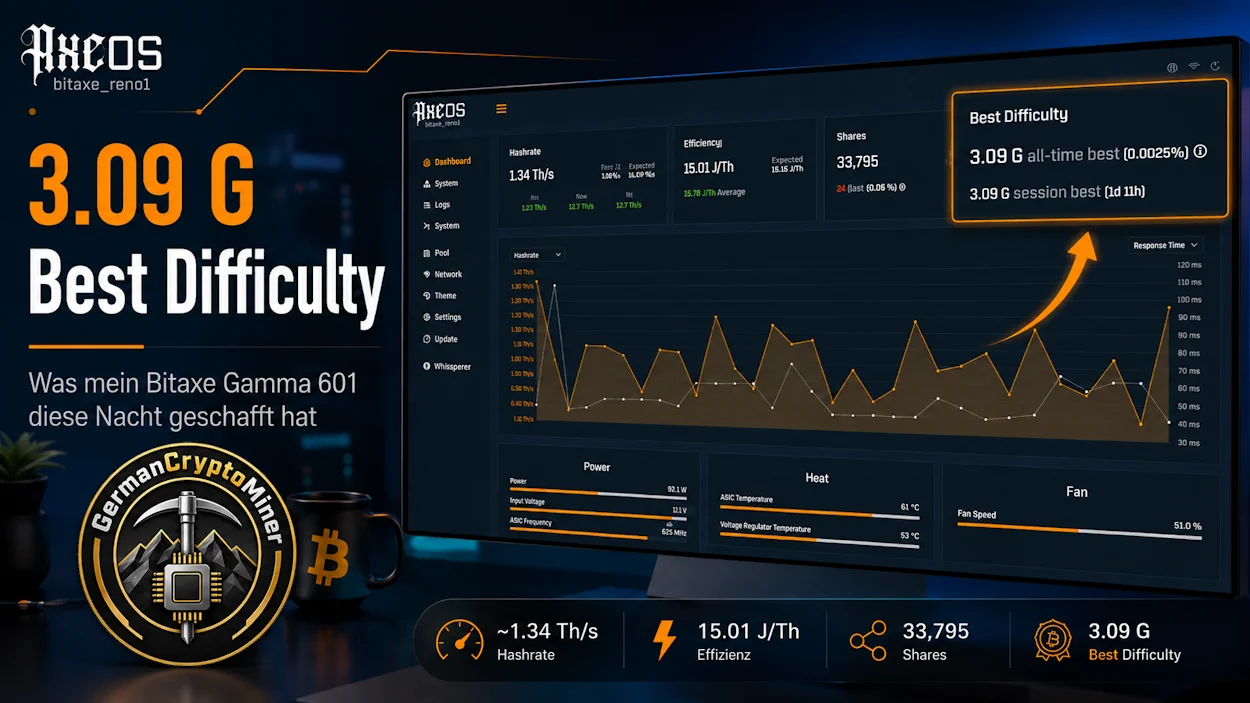
This morning, when I checked the AxeOS dashboard, I had a small “nice” moment. My Bitaxe Gamma 601 had reached a new personal best overnight:
Best Difficulty
3.09 G all-time best (0.0025%)
3.09 G session best (1d 11h)
This is not a block find. It is also not “almost won.” But for such a small miner, it is still a nice value. These are exactly the little moments that make solo mining with a Bitaxe interesting. You do not only see that the device is running. You also see that it is actually working and producing new best values over time.
At the same time, this value shows very clearly why solo mining has to be viewed realistically. 3.09 G sounds big at first. But the 0.0025% shown next to it brings things right back down to earth.
What Does “Best Difficulty” Show?
Best Difficulty shows the best share the miner has found so far. Put simply: the miner constantly tries hashes. Some of them meet a certain difficulty and are counted as shares.
The higher the difficulty of a share, the better that individual result was.
In normal pool mining, people usually look more at regular shares and proportional payouts. In solo mining, Best Difficulty is more interesting because it shows how good the best attempt so far was.
In my case, it says:
3.09 G
That means: my miner found a share with a difficulty of around 3.09 billion.
For a Bitaxe Gamma 601, that is a decent personal value. Nothing more, but also nothing less.
All-Time Best and Session Best
AxeOS shows two values here:
All-time best is the best value the miner has reached overall so far.
Session best is the best value since the last restart or within the current runtime.
In my case, both values were the same:
3.09 G all-time best
3.09 G session best (1d 11h)
That means the miner had been running in this session for about 1 day and 11 hours and reached its best overall value during that time.
For me, that is exactly the nice thing about these small miners. You let them run, check the dashboard later, and see that something actually happened.
The 0.0025% Is the Important Part
Next to the best value, the dashboard shows:
0.0025%
This number is important for putting the result into perspective. It shows how far this share was from the currently required difficulty for a real Bitcoin block.
Roughly calculated:
100% / 0.0025% = 40,000
So the best share was about 1/40,000 of what would have been needed for a valid block.
That sounds much less spectacular than 3.09 G. But this is exactly the point. The miner found a good share. It was not “close to finding a block.”
Why I Am Still Happy About It
Still: I am happy about the value.
Not because anything directly came from it. Not because the miner was close to the jackpot. But because it is a real value from my own setup.
The Bitaxe is running, connecting to the pool, submitting shares, and reaching a new personal best. For a technical hobby project, that is exactly the kind of thing that makes it fun.
These values show:
- the miner is running steadily
- the ASIC is working
- the pool connection is fine
- shares are being found
- the session is producing real results
- the personal best value improved
This is not a major success in an economic sense. But it is a small technical success.
The Current Values From AxeOS
At the time of the screenshot, the dashboard looked quite good overall:
- Hashrate: approx. 1.34 TH/s
- Efficiency: approx. 15.01 J/TH
- Shares: 33,795
- Best Difficulty: 3.09 G
- ASIC temperature: approx. 60 °C
- Power consumption: approx. 20 W
For my Bitaxe Gamma 601, that is a clean run. The hashrate looks right, the efficiency is good, the temperature is not concerning, and the miner is running steadily.
That combination is what makes it interesting: a small BM1370 ASIC on the desk, around 20 watts of power consumption, and real mining data in the dashboard.
A Good Share Is Not a Block
This has to be said clearly: 3.09 G Best Difficulty is not a block find.
A valid Bitcoin block has to meet the current network difficulty. The Best Difficulty value in the dashboard only shows how good the miner’s best share has been so far.
In solo mining, this value can increase again and again over time. Sometimes nothing noticeable happens for a long time, and then suddenly a new best value appears in the dashboard.
That is exciting. But mathematically, it remains a lottery.
A single small miner with around 1 TH/s is tiny compared to the entire Bitcoin network. The theoretical possibility is there. The probability remains extremely small.
Why These Intermediate Values Matter
Because the chance of finding a real block is so small, these intermediate values are interesting. They make it visible that the miner is not just consuming power and showing numbers, but actually participating in the mining process.
You can see:
- the miner is finding shares
- the session is developing
- the best share can improve
- the ASIC is running steadily
- the dashboard values have a real connection to mining
That is one of the main reasons why small solo miners are interesting to me. You get a feeling for how mining works without running a large mining setup.
Solo Mining Remains a Lottery
This value shows quite well why the term mining lottery fits small solo miners.
On one side, there is a small miner on the desk. It runs with modest power consumption, shows its values in AxeOS, and works quietly in the background.
On the other side, there is the global Bitcoin network with enormous computing power.
Between the two is this tiny chance.
That does not make solo mining with a Bitaxe pointless. It just has to be classified correctly. It is not a predictable result. It is a technical experiment with an extremely small theoretical chance of a hit.
Why I Document Values Like This
I do not document values like this because they are huge. I document them because they make the operation easier to understand.
With small miners, a lot happens in the background. The fan runs, AxeOS shows numbers, the miner works. But values like this make it more tangible. You can see development. You can see that the miner is not only online, but actually submitting shares. And you get a better feeling for the scale involved in solo mining.
That is why a value like this belongs on the blog for me. Not as a sensational headline, but as a practical note from real operation.
3.09 G is not a block find. But it is a new personal best. And for a small Bitaxe Gamma 601, that is a good reason to take a closer look.
What I Take From It
The miner did not “almost find a block” overnight. That would be exaggerated. But it did reach a new personal best.
And values like that are exactly what make running the miner interesting.
They are a good way to explain what Best Difficulty means, why good shares are motivating, and why realistic expectations still matter.
For me, this is the right way to look at the Bitaxe Gamma 601: a small piece of Bitcoin mining you can actually touch. Not just theory, not just numbers from the internet, but real values from your own device.